
Some of the best trips are the ones you never intended to take.
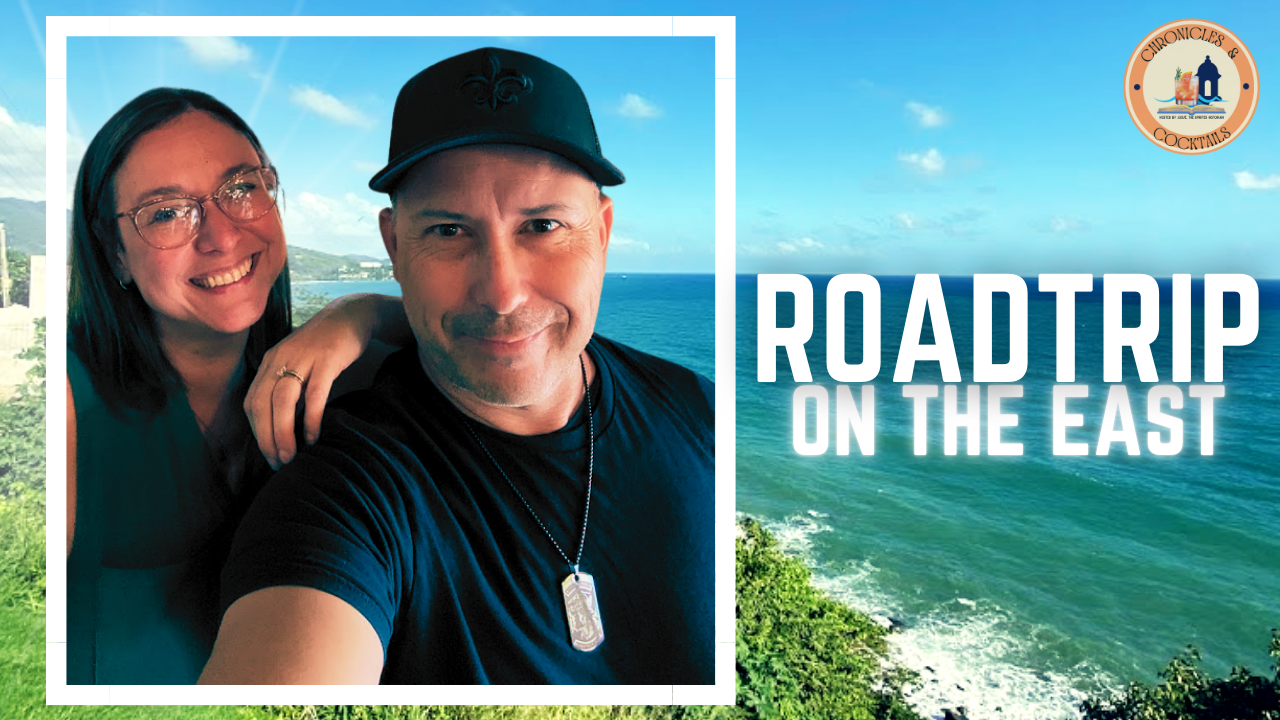
This particular Sunday didn’t begin as a road trip. My wife, Mariela, had work to do. She needed to visit a property in Río Grande for one of the destination weddings she plans in Puerto Rico.
I went along.
That could have been the entire day: drive from San Juan to Río Grande, inspect the property, grab something to eat, and head home.
But that’s rarely how we do things.
Instead, a working Sunday gradually became a drive across a large section of eastern and southern Puerto Rico — through rainforest, coastal highways, old town centers and Christmas-decorated plazas, with stops for breakfast, empanadillas, tapas, whisky and dinner.
It was exactly the kind of Puerto Rico road trip I love.
And perhaps more importantly, it reminded me that even after spending most of your life on this island, Puerto Rico can still surprise you.
Starting in the Rainforest: Hacienda Siesta Alegre
Our day began in the hills of Río Grande at Hacienda Siesta Alegre, roughly 35 minutes east of San Juan and within the rainforest region surrounding El Yunque.
The property is a beautiful Spanish colonial-style, open-air hacienda overlooking Puerto Rico’s northern coast.
It is easy to understand why couples choose places like this for destination weddings. You have the mountains, the tropical vegetation and the architecture all working together. The location itself becomes part of the event.
And that’s why we were there.
Mariela owns MGT Events LLC, a Puerto Rico destination wedding planning company that works with couples coming to the island from around the world.
Her work takes her into some remarkable places: haciendas, historic properties, hotels, cultural venues and locations that many visitors — and sometimes even Puerto Ricans — might otherwise never experience.
MGT Events handles the complicated side of destination weddings: finding venues, coordinating vendors, planning décor, handling guest logistics and bringing all those separate pieces together into one event.
For couples considering a destination wedding in Puerto Rico, you can learn more about MGT Events here:
But once the walkthrough was finished, our working day began turning into something considerably more interesting.
Breakfast in Río Grande
Our next stop was breakfast.
Mariela suggested Ekelekua in Río Grande, one of her favorite places.
I had never been.
That became the first new discovery of the day.
Ekelekua serves a mix of Puerto Rican and American cuisine with European influences, and we settled in for the kind of breakfast that immediately makes you reconsider whatever plans you had for the rest of the morning.
I ordered the Meat Lover’s Omelette: chorizo, bacon, sausage, turkey, Black Forest ham, sautéed peppers, onions and tomatoes, finished with Swiss cheese.
Mariela ordered the Arepa Benedicts: poached eggs served over local arepas with Black Forest ham and house cheese sauce, accompanied by breakfast potatoes.
Add good coffee and fresh passionfruit juice and suddenly there was absolutely no reason to rush home.
So we didn’t.
We got back in the car and kept driving.
Rediscovering Puerto Rico From the Road
There is something about driving around Puerto Rico that I’ve always loved.
The distances aren’t enormous, but the landscape changes remarkably quickly.
You can leave the San Juan metropolitan area, find yourself beside a tropical rainforest, continue toward the Atlantic coast, cross through the mountains and eventually emerge beside the Caribbean Sea — all in the same day.
This route also brought back memories.
When our kids were little, we used to take them around Puerto Rico visiting town plazas. It became one of our ways of exploring the island as a family.
And this eastern route was one of the early ones.
Canóvanas. Río Grande. Luquillo. Fajardo. Ceiba. Naguabo. Humacao. Yabucoa.
They’re names on a map, but driving through them reveals something important about Puerto Rico.
The island isn’t simply San Juan surrounded by beaches.
Puerto Rico is a collection of towns, neighborhoods and communities, each with its own plaza, parish church, food, architecture, geography and history.
That’s why, whenever possible, I like leaving the expressway and driving through the town centers.
You see more.
And you understand more.
Through Maunabo
Eventually we passed through Maunabo, on Puerto Rico’s southeastern coast.
Maunabo sits in the Maunabo Valley, between Yabucoa and Patillas, in one of those corners of Puerto Rico where the mountains seem to fall almost directly into the Caribbean.
The municipality was founded in 1799, but its name reaches considerably further into the island’s past. Maunabo derives from Manatuabón, an Indigenous Taíno name associated with the river.
That’s one of the fascinating things about Puerto Rican geography.
Spanish towns, Catholic churches and colonial plazas were eventually built across the island, but many of the names beneath them remained Indigenous: Utuado, Caguas, Humacao, Yabucoa and Maunabo among them.
The political world changed.
The language changed.
The architecture changed.
But the old names survived.
And as we drove through town, we could also see one of Maunabo’s best-known landmarks in the distance: the old lighthouse overlooking the southeastern coast.
Sometimes history doesn’t require a museum.
Sometimes it’s sitting outside your windshield.
A Chinchorro, Empanadillas and the Caribbean
One of our stops along the southern portion of the route was Kiosko Curet, a small roadside chinchorro.
This is another part of traveling Puerto Rico that shouldn’t be ignored.
The great meal doesn’t always happen inside the famous restaurant.
Sometimes it’s an empanadilla from a little place beside the road.
We tried empanadillas de tiburón and carrucho — shark and conch — with the Caribbean spread out in front of us.
A cold drink. Something fried. Sea breeze.
That’s Puerto Rico, too.
Military aircraft passed overhead while we were there, an interesting reminder of the long military history of eastern Puerto Rico and the former Roosevelt Roads Naval Station in Ceiba.
Then we continued west.
Guayama: History, Christmas and Mapén Mozzarella Sticks
Our next major stop was Guayama.
Guayama was founded in 1736, making it only three years younger than my hometown of Utuado.
We parked beside Plaza Cristóbal Colón, named for Christopher Columbus, and spent some time walking through the historic town center.
Guayama is one of my favorite Puerto Rican towns.
Its history was shaped by agriculture, particularly the sugar economy, while its architecture and urban center preserve evidence of the prosperity and importance the municipality once held in southern Puerto Rico.
But history wasn’t the only reason we stopped.
We found Coppa Bar & Tapas.
And that’s where I encountered the second new discovery of the day:
mapén mozzarella sticks.
Mapén — breadfruit — is deeply embedded in Caribbean cooking, but turning it into a mozzarella stick was something I had never tried.
We also ordered bao buns, had a couple of refreshments and ended up spending considerably more time there than we originally expected.
The food was excellent, but so was the hospitality. The owner, chef and bartenders were friendly, professional and genuinely seemed to enjoy what they were doing.
Those interactions matter when you travel.
A town isn’t just its buildings.
It’s its people.
Afterward, we wandered around the plaza and took in the Christmas decorations before continuing down the road.
Christmas in Salinas
Next came Salinas.
The municipality was founded in 1841, and its identity has long been tied to Puerto Rico’s southern coast, fishing, agriculture and the salt flats that gave the town its name.
We arrived at Plaza Las Delicias, beautifully decorated for Christmas.
Unfortunately, we couldn’t find an open restaurant, coffee shop or bar around the town center at the time.
So we did something simpler.
We walked.
Christmas lights covered the plaza, and for a while that was enough.
One of the pleasures of visiting Puerto Rican plazas during Christmas is seeing how each town interprets the season differently. Decorations change, architecture changes, crowds change — but the plaza remains the gathering place.
That tradition stretches back centuries.
Then we got back into the car.
One final stop.
Cayey: Whisky, Carne Frita and a Perfect Ending
We finished the trip in Cayey, another of our favorite Puerto Rican towns.
By then it was evening, and Plaza Ramón Frade León was fully alive.
Families were walking around. Children were riding the carousel. People were eating and drinking. Christmas lights surrounded the plaza, and the mountain air had that slightly cooler December breeze that makes Cayey feel very different from the coast.
For dinner, we went to Pa’ Pueblo, a whisky bar near the plaza with an extraordinary collection of approximately 400 different whisky labels.
Four hundred.
If you like whisky, you’ll probably find something there.
And that brought me to my third new discovery of the day.
Buka.
A Puerto Rican whisky I had never tasted before.
The brand draws its name from the expression Buka, which it describes as meaning “you are” in the Indigenous Taíno language. Its identity is built around the different peoples and cultures that formed the Caribbean — Indigenous, European, African and the generations that followed.
I had never tried it.
Now I had to.
And since this is Chronicles & Cocktails, discovering a Puerto Rican whisky seemed like an appropriate way to finish the trip.
Dinner was equally interesting.
I ordered carne frita with mangú.
That plate, in a small way, tells a Caribbean story of its own: Puerto Rican carne frita alongside mangú, one of the quintessential foods of the neighboring Dominican Republic.
Mariela went with the salmon nuggets with achiote aioli.
Everything was delicious.
After dinner, we walked around the beautifully decorated plaza for a while before finally getting into the car and heading home.
The Best Part Was What I Didn’t Know
Looking back at the day, something stands out.
For someone who spends so much time exploring Puerto Rico, I encountered several things I had never experienced before.
I had never eaten at Ekelekua.
I had never tried mapén mozzarella sticks.
And I had never tasted Buka Puerto Rican whisky.
That matters.
Because there’s a temptation, especially when you’ve lived somewhere for decades, to think you already know it.
You don’t.
I certainly don’t.
Puerto Rico is too layered for that.
There is always another road, another town, another restaurant, another historical detail, another drink — another story you somehow missed.
And maybe that’s the real reason Mariela and I travel the way we do.
Our trips — whether around Puerto Rico or overseas — tend to revolve around the same things: food, cocktails, art and history.
Sometimes we’re working.
Sometimes we’re traveling.
Most of the time, somehow, we’re doing both.
This Sunday started with a property walkthrough in Río Grande.
It ended after breakfast, hundreds of miles of road, several towns, a chinchorro, tapas, Christmas plazas, dinner and a Puerto Rican whisky in Cayey.
Not bad for a working day.
Watch Chronicles & Cocktails — Episode 30
If you enjoy exploring Puerto Rico beyond the usual tourist stops, subscribe to Chronicles & Cocktails. We travel through the island — and beyond it — looking for the history behind the places, foods, drinks and people we encounter.
And I’ll see you next Sunday…
Be good, be nice, have fun, get smart, read a lot, travel, go to church, and Salud!