
Puerto Rico is a small island. Its influence is anything but small.
Across different periods of history, Puerto Rico and Puerto Ricans have left fingerprints on what the world drinks, eats, listens to, manufactures, plays, and even sends into space.
Some of those contributions are obvious. Puerto Rican rum and reggaetón need little introduction today. Others are surprisingly obscure. A fast-food item eaten around the world has a Puerto Rican origin story. An innovation associated with modern basketball has an unexpected connection to Guaynabo. Puerto Rican scientists and physicians have participated in medical advances whose consequences extend far beyond the Caribbean.
That raised a question worth exploring:
What has Puerto Rico actually contributed to the world?
Not just to the United States. To the world.
From Coffee and Sugar to Rum
Long before Puerto Rico became known primarily as a Caribbean tourist destination, its mountains and coastal valleys were connected to international commerce.
During the nineteenth century, Puerto Rican coffee became an important export, particularly from the mountainous interior. Coffee produced in places such as Utuado, Adjuntas, Lares and Yauco entered European markets and helped make coffee one of Puerto Rico's most important agricultural products.
Sugar tells a different—and considerably more complicated—story.
The rise of sugar connected Puerto Rico to the enormous Atlantic economy built around one of the world's most valuable commodities. Sugar affected land ownership, labor, migration, industrialization and international trade. Its history also includes slavery and exploitation, making it impossible to tell honestly as simply a story of economic success.
And then there is what came from sugarcane and molasses:
rum.
Puerto Rico eventually became one of the great rum-producing centers of the world. Names such as Don Q, Ron del Barrilito, Palo Viejo and, after its arrival from Cuba, Bacardí became part of a much larger Puerto Rican rum industry.
That contribution continues every time somebody thousands of miles away pours Puerto Rican rum into a glass.
For that reason, the cocktail in this episode is unusually simple.
There isn't one.
We're drinking rum.
Puerto Rico You Can Hear
Puerto Rico's exports haven't all traveled aboard ships.
Some traveled on cassette tapes.
The musical movement that developed in Puerto Rico's underground scene during the late twentieth century eventually became reggaetón, one of the most commercially successful musical genres of the twenty-first century.
What began as a mixture of influences—including reggae en español, dancehall, hip-hop and Puerto Rico's own urban environment—eventually escaped the underground.
Today you can hear its rhythms from San Juan to Madrid, Tokyo, London and Buenos Aires.
That is cultural influence on an extraordinary scale.
Puerto Rico in Medicine
One of the more fascinating parts of this story is also one of the least visible.
Puerto Rico became an important center for pharmaceutical manufacturing during the second half of the twentieth century. Medicines and medical products manufactured on the island entered supply chains reaching patients far beyond Puerto Rico.
But manufacturing is only part of the story.
Puerto Rico also played a significant role in the history of the oral contraceptive pill, with major clinical trials conducted on the island during the 1950s. Those trials helped lead to a drug that profoundly altered family planning and modern society, although the circumstances surrounding the Puerto Rican trials also raise serious historical questions about informed consent and medical ethics.
Puerto Rican researchers later helped achieve remarkable progress in preventing the transmission of HIV and syphilis from mothers to their children.
These are very different stories, but together they reveal something rarely associated with the popular image of Puerto Rico:
The island has been an important participant in the history of modern medicine.
And Then There Is Space
Perhaps the strangest journey in this episode begins in Patillas and ends hundreds of miles above Earth.
Puerto Rican engineer Olga D. González-Sanabria became an important figure at NASA Glenn Research Center. Her technical work contributed to the development of long-life nickel-hydrogen battery technology used for space applications, including the International Space Station.
Think about that for a moment.
An engineer from a small municipality on Puerto Rico's southeastern coast helped develop technology connected to humanity's permanent presence in orbit.
Puerto Rico's story doesn't stop at the shoreline.
It doesn't even stop on Earth.
So What Are Puerto Rico's Top Ten Contributions?
That's where I'm going to stop.
Because there are ten stories in the new episode of Chronicles & Cocktails, and I'm not giving away the countdown here.
Some are consequential.
Some are surprising.
One may change the way you look at basketball.
Another might make you look differently at the next fast-food menu you see.
And several reveal just how deeply this small Caribbean island has participated in much larger chapters of world history.
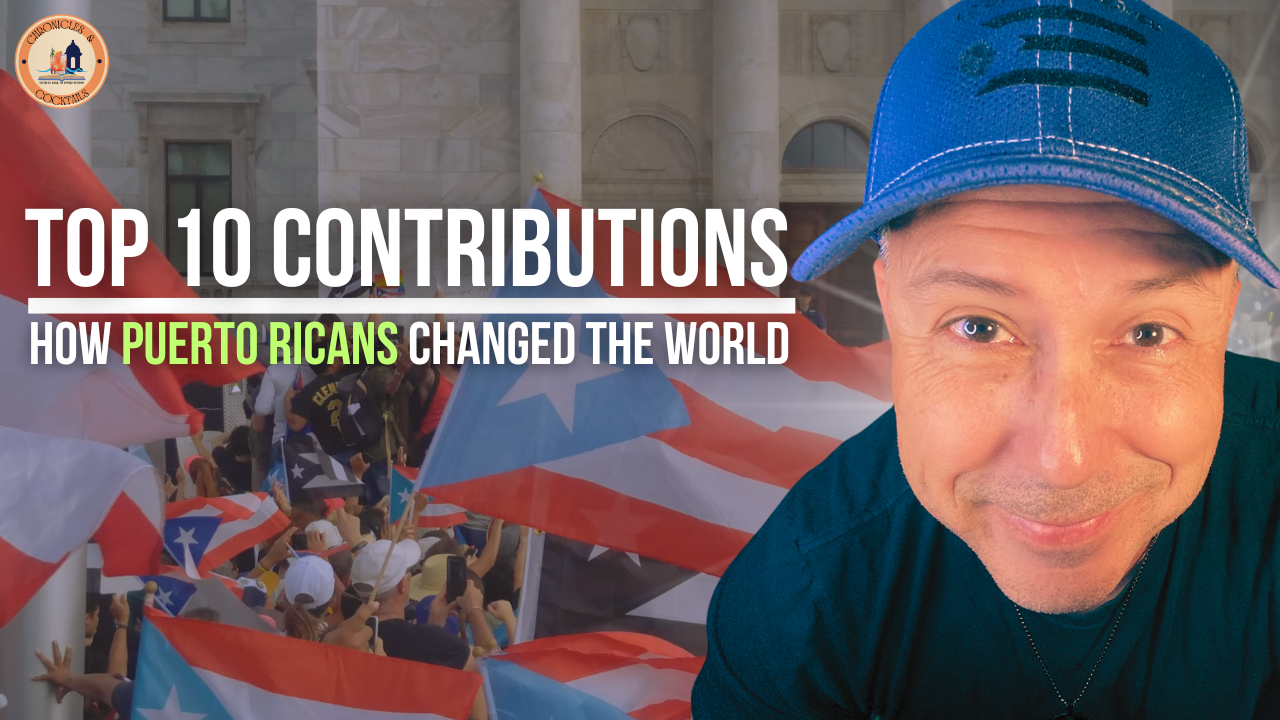
Grab a glass—rum is particularly appropriate for this one—and join me as we count down 10 Things Puerto Rico Gave the World.
Watch the full episode of Chronicles & Cocktails to discover all ten—and find out what made #1.

Chronicles & Cocktails explores Puerto Rico through history, travel, food and drink—looking beyond the postcard to understand the people, places and events that made the island what it is today.