
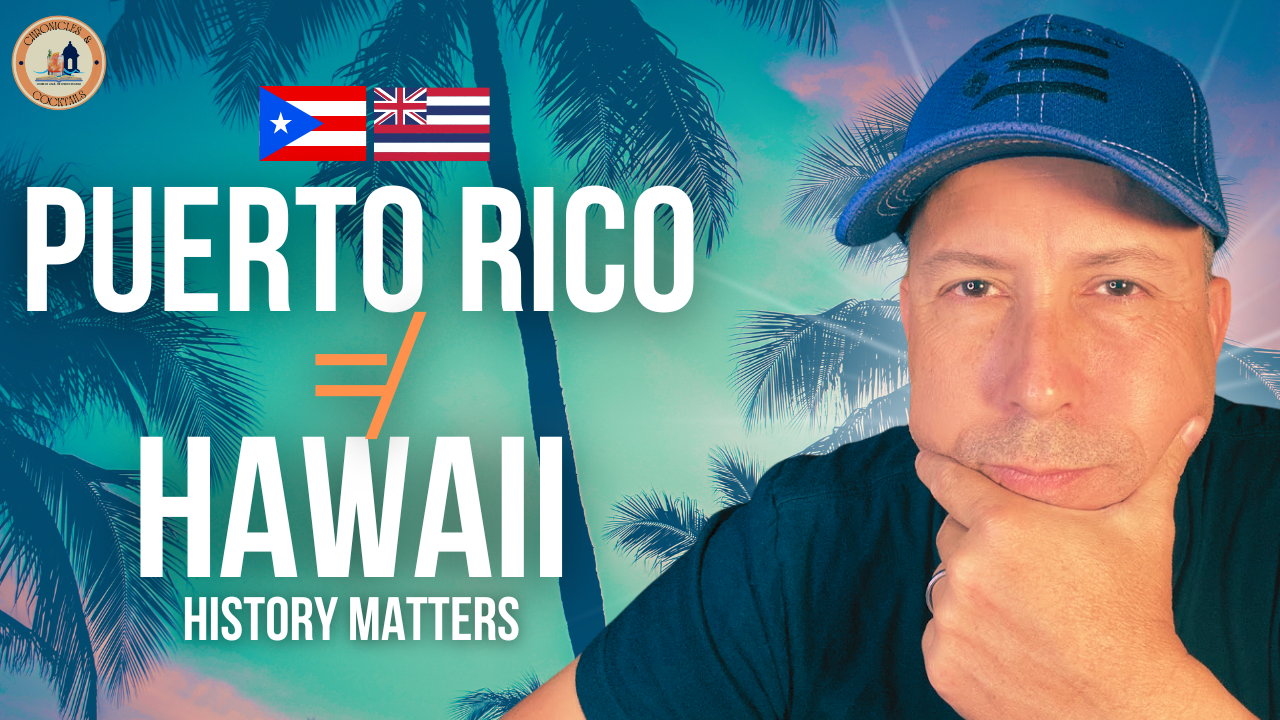
Whenever the future of Puerto Rico comes up, particularly in conversations about political status, one comparison seems almost inevitable:
Hawaii.
The argument usually goes something like this: Hawaii was an island territory of the United States, eventually became a state, and Puerto Rico could simply follow the same path.
Or, depending on who's making the argument, Hawaii is presented as a warning of what Puerto Rico could become.
There's just one problem.
Puerto Rico is not Hawaii.
The two islands certainly have similarities. Both occupy strategically important positions in their respective regions. Both came under American control during the era of U.S. expansion. Both have complicated relationships with the United States. And both developed distinctive cultures that remain very much alive today.
But once we move beyond those similarities, the comparison begins to fall apart.
Two Islands, Two Very Different Histories
Before American annexation, Hawaii had been an internationally recognized independent kingdom with its own monarchy, government, diplomatic relationships, and political institutions.
Puerto Rico entered American rule from an entirely different direction.
By 1898, Puerto Rico had spent more than four centuries within the Spanish world. Spain had shaped the island's municipalities, laws, architecture, religion, language, agriculture, customs, and political institutions.
San Juan had already been standing for centuries. Towns had developed around plazas and Catholic churches. Generations of Puerto Ricans had been born into a society whose cultural foundations were deeply connected to Spain and the broader Hispanic world.
Then came the Spanish-American War.
Puerto Rico passed from Spanish to American sovereignty in 1898.
Hawaii's political transformation followed a different chronology, involving the overthrow of the Hawaiian monarchy in 1893, the Republic of Hawaii, American annexation in 1898, territorial government, and eventually statehood in 1959.
Those aren't minor differences.
They are fundamentally different historical experiences.
Culture Doesn't Follow a Political Formula
One of the biggest problems with using Hawaii as a prediction for Puerto Rico is the assumption that political status automatically determines cultural identity.
History is rarely that simple.
More than a century after the United States acquired Puerto Rico, Spanish remains the dominant language of everyday Puerto Rican life. Catholicism and Christianity remain important elements of the island's historical and cultural landscape. Puerto Rico's traditional towns still revolve around institutions and urban patterns inherited from centuries of Spanish rule.
Puerto Rican identity has certainly evolved under American sovereignty—but it didn't disappear.
That's important when discussing Puerto Rico's future.
Whether someone favors statehood, independence, the current territorial arrangement, or another political solution, the debate should begin with Puerto Rico's actual history rather than assuming another island provides a ready-made template.
And Then There's the Land
Land ownership is another reason the comparison deserves closer examination.
Hawaii experienced enormous changes in land ownership and economic power during the nineteenth and twentieth centuries, including transformations that began even before American annexation.
Puerto Rico had its own dramatic economic changes after 1898, particularly with the expansion of large-scale sugar production and American investment.
Both stories deserve serious examination.
But they aren't interchangeable.
And compressing them into a simple "Puerto Rico could become another Hawaii" narrative does a disservice to both Puerto Ricans and Hawaiians.
The Cocktail: A False Equivalence
Of course, this is Chronicles & Cocktails, so history eventually reaches the bar.
For this episode, I make a deliberately simple drink I've called the False Equivalence.
The name comes from the logical mistake at the heart of the episode: assuming that because two things share certain characteristics, they must therefore be equivalent.
Two islands.
Two American territories.
Two complicated histories.
But not the same history.
And definitely not the same people.
Puerto Rico Has Its Own Story
Puerto Rico doesn't need Hawaii to explain what it is.
Neither should Hawaii be reduced to a political analogy used to argue about Puerto Rico.
Understanding the differences doesn't mean ignoring the fascinating similarities between the islands. Those similarities are worth studying—and some of them are remarkable.
But comparison should help us understand history, not replace it.
In this episode of Chronicles & Cocktails, we take a closer look at the histories behind the comparison, why the differences matter, and what both islands can teach us about the danger of forcing complicated histories into simple political arguments.
Watch the full episode of Chronicles & Cocktails: The Problem With Comparing Puerto Rico to Hawaii and join me as we separate the similarities from the history—and, naturally, make a cocktail along the way.
History. Culture. Travel. Cocktails. Puerto Rico.
I’ll see you next Sunday… be good, be nice, have fun, get smart, read a lot, travel, go to church, and Salud!
