
Puerto Rico is usually associated with baseball, boxing, basketball, and an extraordinary tradition of athletes who have represented the island around the world. American football is different. Puerto Rico has no NFL franchise, and the sport has never occupied the same place in island culture that baseball does.
And yet, Puerto Rico has been part of the NFL story for decades.
Look beyond the uniforms and statistics and you begin to find something familiar: Puerto Rican parents and grandparents, families moving between the island and the mainland, children maintaining connections to places they may never have called home themselves, and—in a few cases—players whose football stories actually began in Puerto Rico.
That makes the story of Puerto Ricans in the NFL about considerably more than football.
It is also a story about genealogy.
Puerto Rican Roots Behind NFL Names
One of the most recognizable examples today is Isiah Pacheco, the Kansas City Chiefs running back whose father, Julio, comes from Ponce, Puerto Rico. Pacheco has publicly embraced that part of his heritage, including celebrating with the Puerto Rican flag after winning the Super Bowl.
But Pacheco represents only one version of the story.
Trystan Colon, for example, has particularly strong family connections to the island. His parents grew up in Puerto Rico, and Colon spent summers here as a child. Those visits helped connect a mainland-born son to the places, language, and culture of his parents.
Then there is Chris Rodriguez Jr., whose Puerto Rican ancestry reaches another generation back. His grandfather was born in Puerto Rico before the family established itself on the mainland.
Those differences matter.
First generation. Second generation. Third generation.
The names and circumstances change, but genealogically they are chapters of the same enormous Puerto Rican migration story that accelerated during the twentieth century.
Other NFL players with Puerto Rican family connections have included Cesar Ruiz, Marco Wilson, Bobby Price, Elijah Wilkinson, and others.
And then there is Federico Maranges.
From Dorado to Professional Football
Maranges makes this story especially interesting because his connection to Puerto Rico isn't simply ancestral.
He was born in Dorado and grew up in Puerto Rico, playing youth football on the island before eventually moving to Florida following Hurricane Maria.
That is a very different route from the traditional NFL pipeline.
Puerto Rico isn't Texas, Florida, Pennsylvania, or Ohio. A child growing up here doesn't have anything resembling the enormous high-school and college football infrastructure available in many states.
That makes Maranges' journey particularly significant for the development of American football on the island.
It also raises an interesting historical question: as football continues to develop in Puerto Rico, could future generations of Puerto Rican NFL players increasingly come directly from the island rather than primarily from the diaspora?
The Boricuas Who Came Before
None of this began with today's players.
Ron Rivera, whose father was Puerto Rican, played linebacker for the Chicago Bears and became a Super Bowl champion before embarking on a long NFL coaching career.
Victor Cruz became one of the most recognizable Puerto Rican figures in modern football while playing wide receiver for the New York Giants. His famous salsa touchdown celebration became part of his public identity and a tribute to the Puerto Rican grandmother who helped raise him.
Other players with Puerto Rican roots have contributed their own chapters to this history, from linemen to defensive stars and specialists.
Their stories remind us of something easily overlooked when discussing Puerto Rican history: Puerto Rican history does not stop at the shoreline.
It follows Puerto Ricans wherever they go.
Football, Migration and Genealogy
That may be the most interesting part of this story.
Take away the helmets for a moment and many of these family histories resemble millions of other Puerto Rican stories.
Someone leaves Puerto Rico.
A family settles in New York, New Jersey, Florida, California or somewhere else on the mainland.
Children are born.
Then grandchildren.
English sometimes becomes their first language. Puerto Rico becomes the place where Grandma was born, where Dad grew up, or where the family spends summers.
But something survives.
A surname. A recipe. A story. A photograph. A hometown. A flag.
Sometimes it even survives on an NFL helmet.
That is why looking at Puerto Ricans in professional football through genealogy gives us a much richer story than simply compiling a list of players.
These athletes are individual branches of a much larger Puerto Rican family tree.
Puerto Rico and America's Biggest Game
Super Bowl weekend gives us the perfect excuse to tell that story.
Millions will watch the game. Millions more will watch the commercials and halftime show. Puerto Rico's cultural presence in the event is particularly visible this year with Bad Bunny taking one of the world's largest entertainment stages.
But Puerto Rico's relationship with the NFL did not begin with a halftime performance, and it certainly doesn't end there.
There are Boricua stories buried throughout the league's history.
You just have to know where to look.
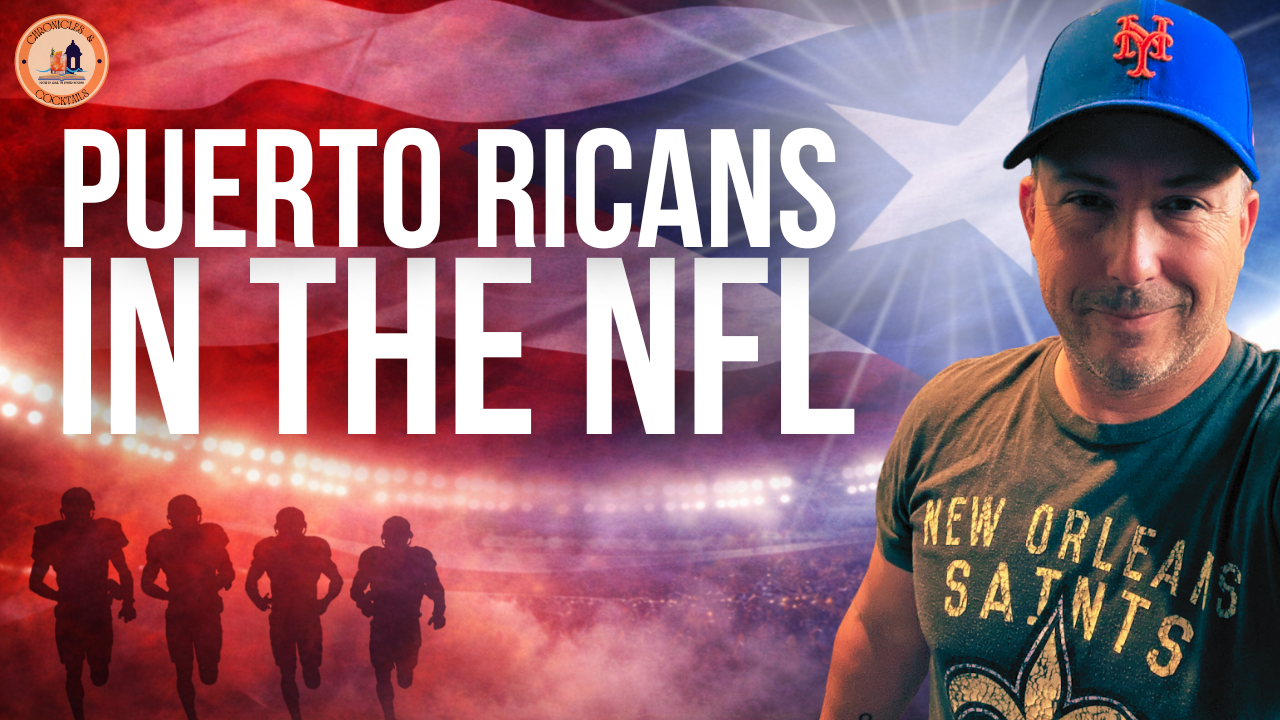
And in the latest episode of Chronicles & Cocktails, that is exactly what we do.
We trace Puerto Rican bloodlines through the NFL, look at the families behind several players, travel from Ponce and Dorado to NFL stadiums, revisit pioneers such as Ron Rivera and Victor Cruz, and explore why the story of Puerto Ricans in professional football is ultimately another chapter in the history of the Puerto Rican diaspora.
Because sometimes history isn't sitting quietly inside an archive.
Sometimes it's wearing a helmet.
Watch the full episode of Chronicles & Cocktails: Puerto Ricans in the NFL: From the Island to the League.
