
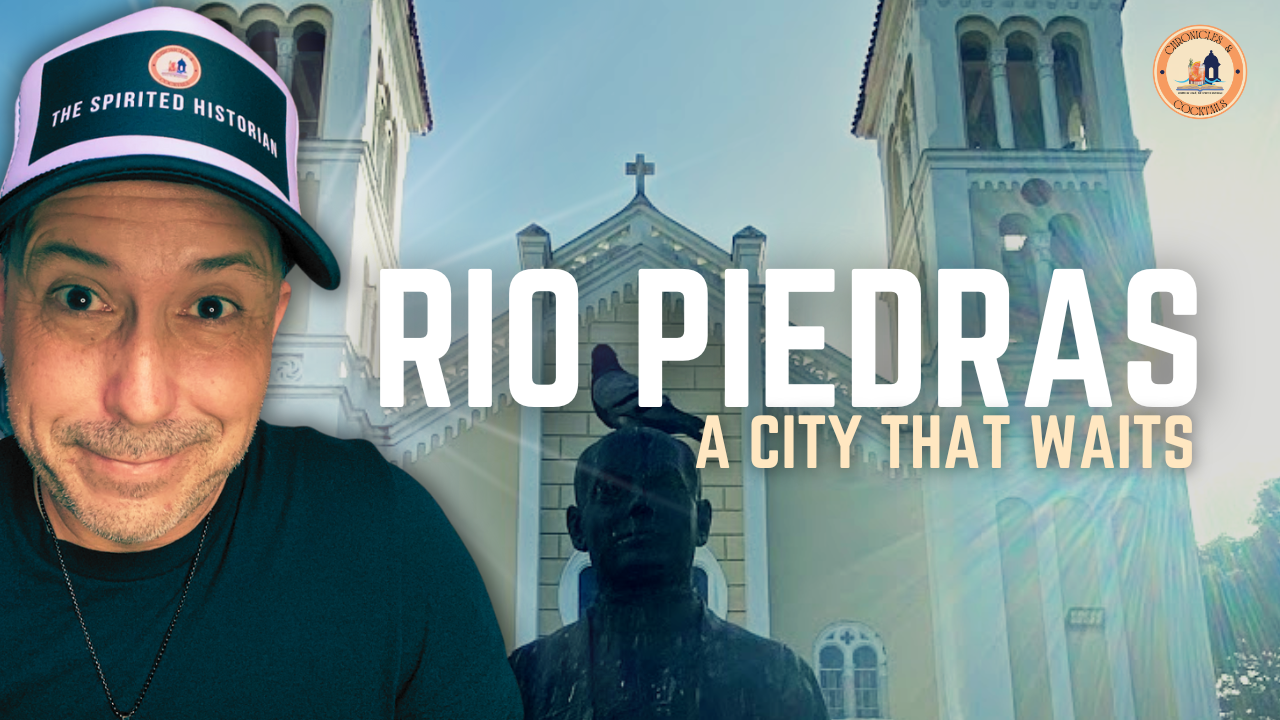
Río Piedras is one of those places in Puerto Rico that almost everyone knows, thousands pass through every day, and surprisingly few people actually stop to look at.
Founded in 1714 as El Roble, Río Piedras began as a transit town—a place along the road rather than the final destination. Cattle, agriculture, roads and travelers came long before universities, hospitals and urban sprawl.
And yet, somewhere along the way, this small town became one of Puerto Rico's great centers of education, medicine, commerce, culture and political thought.
It became its own municipality. It became a university town. It became a commercial center. And eventually, in 1951, the municipality of Río Piedras was incorporated into San Juan.
Today, Río Piedras is officially part of Puerto Rico's capital.
But spend a few hours walking its streets and you quickly realize something:
Río Piedras is still Río Piedras.
For this episode of Chronicles & Cocktails, I went there not simply to tell its history, but to spend a day experiencing the place—walking the old town, eating at the market, visiting the university, looking for books, crossing the river and eventually ending the day the way many good days should end: at a fonda with my wife and a cold beer.
The principal historical source accompanying me was a book I found while exploring Río Piedras itself: Río Piedras: Notas para su historia. Notas para su Historia Río Pied…
From El Roble to Río Piedras
The Río Piedras of today can make its origins difficult to imagine.
Highways surround it. The Tren Urbano passes through it. Universities, hospitals, apartment buildings and dense neighborhoods occupy a landscape that was once considerably more rural.
The early settlement developed around movement, agriculture and the routes connecting the interior with San Juan. That identity as a crossing point would prove remarkably persistent.
Río Piedras would change dramatically, but movement would remain part of its DNA.
People came through to trade.
Later, they came to shop.
They came to study.
They came to protest.
They came for medical treatment.
And many stayed.
That transformation from a rural settlement into an important urban center is one of the themes running through the history preserved in Río Piedras: Notas para su historia. Notas para su Historia Río Pied…
The Pueblo
I began where old Puerto Rican towns usually make the most sense: the plaza and the church.
Walk around the traditional center of Río Piedras and the original logic of the town is still visible beneath everything that came afterward.
The parish church faces the plaza. Streets radiate outward. Commerce occupies the surrounding blocks.
It is the familiar urban vocabulary inherited from centuries of Spanish town planning: church, plaza, government, commerce and community within walking distance of one another.
There are beautiful architectural details here, but there are also scars.
Some buildings are maintained.
Others have clearly seen better decades.
And that contradiction becomes impossible to ignore.
Río Piedras remains enormously important to metropolitan San Juan while portions of its historic center appear forgotten.
That makes walking here simultaneously fascinating and frustrating.
Paseo de Diego: When Río Piedras Went Shopping
Few places illustrate that contradiction better than Paseo de Diego.
For generations, Río Piedras was one of the major commercial centers of metropolitan Puerto Rico. People came here to shop, eat, meet and conduct business.
The pedestrianized Paseo de Diego became one of the recognizable symbols of that commercial Río Piedras.
Today, you encounter something different.
There are businesses operating, people walking and commerce continuing—but there are also shuttered storefronts, worn buildings and reminders of a much busier commercial past.
Walking there, one of the lines I recorded for the episode seemed particularly appropriate:
“Every closed gate here tells a story. Every open one tells another.”
Río Piedras isn't dead.
That description would be both lazy and inaccurate.
But it is clearly a town center negotiating with its own past.
Plaza del Mercado: History Gets Hungry
Then there is the market.
And this is where lofty discussions about urban history become considerably more practical.
Because eventually, I was hungry.
Inside the Plaza del Mercado de Río Piedras, lunch was wonderfully uncomplicated:
rice, beans and beef stew.
No reinterpretation.
No foam.
No twenty-seven-dollar plate attempting to explain Puerto Rican identity to me.
Just lunch.
And places like this matter historically precisely because they are ordinary.
Markets document what people actually eat, buy and do. They preserve routines that rarely make it into political histories or monuments.
Cities don't survive on nostalgia.
They survive on people showing up tomorrow morning.
The University Changed Everything
Then you reach the institution that fundamentally altered the trajectory of Río Piedras: the University of Puerto Rico.
The University of Puerto Rico was established in Río Piedras in 1903, developing from the Normal School established in Fajardo in 1900. What followed would profoundly affect not only Río Piedras but Puerto Rico itself.
The university brought students, professors, writers, researchers, political movements, businesses, boarding houses and bookstores.
Río Piedras became a place where ideas were produced—and argued about.
During my visit I walked around the iconic tower and visited the library.
And while I was filming, the tower bells began ringing.
Sometimes you get lucky.
I stopped talking.
The bells could explain the place better than I could.
For more than a century, generations of Puerto Ricans have passed through this campus. Governments have changed. Political movements have risen and fallen. Students have arrived, graduated and been replaced by another generation.
The bells keep marking time.
A Town of Books
A university town should have bookstores.
Río Piedras does.
I spent part of the day browsing them, and there I found something that ultimately became important to this very episode: Río Piedras: Notas para su historia. Notas para su Historia Río Pied…
There is something wonderfully appropriate about going to Río Piedras to research Río Piedras and leaving with a book about Río Piedras.
Local histories like this are valuable because much of what makes a community important never reaches the sweeping histories of a country.
Street names.
Families.
Institutions.
Buildings.
Businesses.
Small events that were enormous to the people who actually lived them.
Cities that matter eventually write themselves down.
Fortunately, somebody bothered to do it here.
Centro Médico: The City That Heals
Drive away from the traditional town center and another Río Piedras emerges.
Centro Médico.
The area has become the center of Puerto Rico's most important concentration of specialized medical institutions and teaching hospitals.
And there is an interesting continuity here.
The original Río Piedras mattered partly because people moved through it.
Three centuries later, they still do.
Only now some arrive in ambulances.
Others are medical students, nurses, physicians, researchers, patients or worried relatives carrying coffee through hospital corridors at an unreasonable hour.
The landscape changed.
The function of Río Piedras as a place people depend upon did not.
Finding the Río in Río Piedras
Then I went looking for something embarrassingly easy to forget.
The actual Río Piedras.
I stopped at a bridge and filmed the river below.
In a metropolitan landscape dominated by concrete, highways and buildings, the river can almost feel like an afterthought.
It isn't.
Geography came first.
The city followed.
Standing there also brought the entire story back to one of Río Piedras' oldest characteristics: movement.
Water moves.
Roads move people.
Universities move ideas.
Hospitals move knowledge.
And Río Piedras has spent more than three centuries sitting at the crossing.
A Brief Escape Into the Botanical Garden
Not far away is another side of Río Piedras entirely: the Botanical Garden of the University of Puerto Rico.
After streets, traffic, storefronts, hospitals and concrete, suddenly there are trees.
Quiet.
Space.
Green.
I only spent a short time there during this visit, but it provided exactly what the episode needed.
A pause.
Even thinking cities need somewhere to breathe.
Houses Tell History Too
I also spent time simply driving.
That matters.
The architecture of Río Piedras changes as you move through its neighborhoods. Older houses coexist with apartment buildings, commercial structures and the expanding footprint of metropolitan San Juan.
Architecture is often one of the most honest historical documents available.
A building tells you what people could afford.
What climate they were responding to.
What materials were available.
What they considered beautiful.
And sometimes, unfortunately, what later generations decided wasn't worth maintaining.
You don't always need a plaque.
Sometimes you just need to look out the window.
One More Fonda
Eventually I met Mariela at one of our favorite fondas.
She had a smoked pork chop with tostones and fresh salad.
I had already eaten earlier at the market, so I made the responsible historical decision and ordered a cold beer.
No cocktail.
No garnish.
No lecture.
Just a beer.
Because history is ultimately not something that exists exclusively in archives, monuments or university libraries.
It's also the places you return to.
The table you recognize.
The person sitting across from you.
And the food you already know you're going to order before somebody hands you the menu.
The Cocktail: El Cruce
For the Chronicles & Cocktails cocktail segment, however, Río Piedras deserved something of its own.
So I created El Cruce.
The idea is intentionally simple: chichaíto and sweet vermouth.
Chichaíto brings something unmistakably Puerto Rican—rum, anise, neighborhood bars and familiar habits.
Vermouth brings another tradition: the café, the aperitif, the long conversation over a small drink.
Put them together and you have a crossing.
And that seemed appropriate.
Because Río Piedras began as a transit town.
Three centuries later, it remains a place where things cross:
people, cultures, food, medicine, education and ideas.
So, El Cruce.
No smoke machine required.
Río Piedras Is Still Here
It would be easy to finish an episode like this by talking exclusively about decline.
That would also miss the point.
Yes, parts of Río Piedras look tired.
Yes, Paseo de Diego is a shadow of the commercial powerhouse it once was.
Yes, beautiful buildings need attention.
But Río Piedras is simultaneously home to universities, researchers, hospitals, students, businesses, markets, restaurants, immigrants, longtime residents and institutions upon which the rest of Puerto Rico depends.
That's the contradiction.
A place can be struggling and important at the same time.
A town can lose its municipality and retain its identity.
A commercial center can fade while an intellectual center survives.
Río Piedras has spent more than 300 years becoming something different from what it was supposed to be.
It started as a place you passed through.
Maybe the mistake today is that we still pass through too quickly.
Slow down.
Walk the plaza.
Eat at the market.
Browse the bookstores.
Listen when the university bells ring.
Find the river.
And look around.
Río Piedras remembers everything.
We should probably pay attention.
