
When most people think about turkey in Puerto Rico, they immediately think of Thanksgiving, pavochón, cranberry sauce, and family gatherings. Because Thanksgiving is an American holiday, many assume the turkey arrived on the island only after the United States took possession of Puerto Rico in 1898.
The truth is far more interesting.
Turkey was already present in Puerto Rico during the Spanish colonial period. It appears in historical records, colonial observations, and even in one of the earliest Puerto Rican cookbooks decades before the American flag ever flew over San Juan. Yet it wasn’t an everyday food. It wasn’t a symbol of celebration. Instead, it slowly evolved from an occasional bird into one of Puerto Rico’s most beloved holiday traditions.
Its story is one of adaptation—the same story that defines much of Puerto Rican culture.
The Turkey Is an American Bird
One of the biggest misconceptions is that turkey is somehow a European tradition.
In reality, the turkey is native to the Americas.
The wild turkey (Meleagris gallopavo) originated in what is now Mexico and the southern United States. Archaeological evidence shows that Indigenous peoples of Mesoamerica domesticated turkeys more than 2,000 years ago, long before Europeans arrived in the Western Hemisphere.
When Spanish explorers encountered the bird during the sixteenth century, they brought it back across the Atlantic. From there, turkey spread rapidly through Europe, becoming a fashionable bird among royal courts and wealthy households.
Ironically, Europe discovered the turkey because of the Americas—but Puerto Rico would take much longer to embrace it as part of its own culinary identity.
Turkey in Spanish Puerto Rico
One of the most valuable windows into eighteenth-century Puerto Rico is Fray Iñigo Abad y Lasierra’s monumental work, Historia geográfica, civil y natural de la isla de San Juan Bautista de Puerto Rico.
Abad y Lasierra carefully documented the island’s geography, economy, agriculture, livestock, and everyday life.
His observations reveal something fascinating.
Turkeys were indeed present in Puerto Rico during the late 1700s.
However, they were not a common part of the average family’s diet.
On page 192, Abad explains that most turkeys were destined for sale in the markets and ports of the capital rather than regular household consumption. When island residents did eat turkey, it was generally out of necessity rather than preference.
That small detail tells us a great deal.
The turkey existed.
Puerto Ricans knew the bird.
But it had not yet become culturally significant.
Unlike pork, beef, chickens, or locally available foods, turkey occupied only a small corner of Puerto Rico’s food economy during the Spanish colonial era.
The First Turkey Recipes Printed in Puerto Rico
Everything changes in 1859.
That year, an anonymous cookbook titled El Cocinero Puerto-Riqueño was published.
Among its recipes are what appear to be the earliest printed turkey recipes produced on the island.
Two stand out:
- Pavo relleno a lo criollo
- Pepitoria de pavo y de gallina
These recipes are historically significant because they prove that Puerto Rican cooks had already begun adapting turkey to local tastes decades before American rule.
“Pavo relleno a lo criollo” wasn’t simply roasted turkey.
It reflected the island’s culinary identity by incorporating ingredients and techniques familiar to Puerto Rican kitchens.
Likewise, pepitoria—a dish inherited from Spanish culinary traditions—demonstrates how colonial recipes evolved within Puerto Rico’s own food culture.
Turkey may not have been common, but by the mid-nineteenth century it had clearly entered Puerto Rican cooking.
Then Came 1898
When Puerto Rico became part of the United States after the Spanish-American War, another chapter began.
With American administration came new holidays, new commercial products, and new traditions.
Among them was Thanksgiving.
Unlike Christmas, which already had centuries of history in Puerto Rico, Thanksgiving was largely unfamiliar.
Yet Puerto Ricans did what they have always done throughout history.
They adapted.
Families living in New York, Chicago, Philadelphia, Connecticut, and elsewhere embraced Thanksgiving while preserving their own traditions.
When they gathered around the table, turkey became the centerpiece—but everything around it remained unmistakably Puerto Rican.
Arroz con gandules.
Pasteles.
Tembleque.
Potato salad.
And eventually…
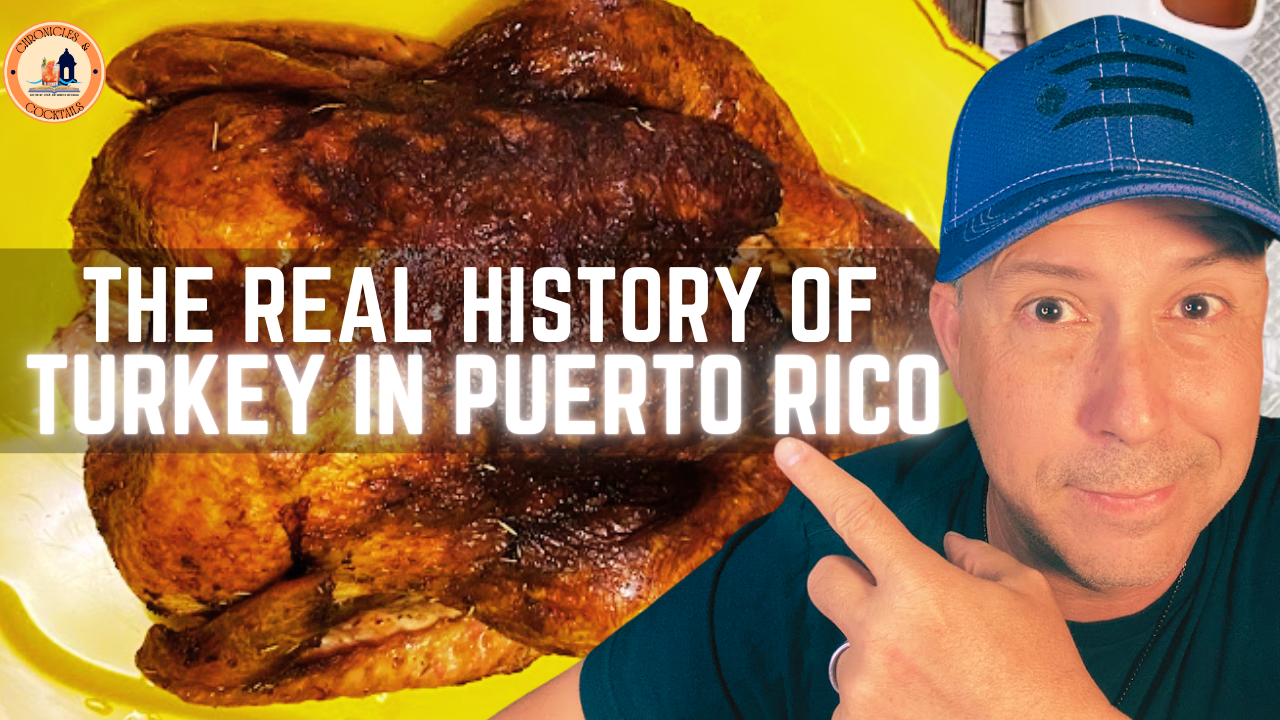
Pavochón.
Pavochón: The Bird That Became Boricua
Perhaps no dish tells Puerto Rico’s story better than pavochón.
The name itself combines two words:
Pavo (turkey)
Lechón (roast pork)
Instead of preparing turkey according to traditional American recipes, Puerto Rican cooks seasoned it exactly the way they prepared roast pork.
Garlic.
Oregano.
Adobo.
Sour orange.
Achiote.
Sometimes even stuffing it with mofongo.
The result wasn’t simply turkey.
It became something entirely new.
The bird may have come from somewhere else.
The flavor became Puerto Rican.
Pavochón perfectly illustrates one of the defining characteristics of Puerto Rican culture:
We don’t simply adopt traditions.
We transform them.
Turkey in Twentieth-Century Puerto Rican Cookbooks
As turkey became more common, it also appeared more frequently in Puerto Rican cookbooks.
One example is The Puerto Rican Cook Book, published in 1944 by Eliza B.K. Dooley.
By the mid-twentieth century, turkey recipes had become familiar enough to appear naturally alongside other Puerto Rican dishes.
Another remarkable source is Mi Colección de Recetas, published in 1961 by Rosa P. Hernández of Utuado.
Unlike mass-market cookbooks, this was a limited publication that reflected home cooking traditions passed from one generation to another.
Together, these books illustrate turkey’s gradual journey from colonial curiosity to holiday staple.
More Than Thanksgiving
Today, many Puerto Rican families wouldn’t imagine Thanksgiving without turkey.
Others remain loyal to pernil.
Many serve both.
That’s part of what makes Puerto Rican cuisine so fascinating.
It doesn’t force tradition into rigid categories.
Instead, it welcomes influences and reshapes them.
Turkey isn’t “less Puerto Rican” because it wasn’t always here.
Neither are potatoes, coffee, oranges, or countless other foods that eventually became part of our identity.
Culture isn’t frozen in time.
It’s constantly evolving.
The Cocktail: The Borinquen Cranberry-Rum Cooler
Every episode of Chronicles & Cocktails pairs history with a cocktail inspired by the story.
For this episode, the featured drink is the Borinquen Cranberry-Rum Cooler.
Its ingredients tell the same story as the turkey itself.
- Puerto Rican aged rum represents the island’s Caribbean heritage.
- Cranberry reflects the American Thanksgiving tradition.
- Pineapple reminds us of Puerto Rico’s tropical identity.
- Cinnamon, nutmeg, and vanilla evoke the colonial spice traditions that shaped Puerto Rican kitchens for centuries.
Like pavochón, this cocktail blends influences without losing its identity.
A Story Bigger Than a Bird
The history of turkey in Puerto Rico isn’t really about turkey.
It’s about adaptation.
It’s about migration.
It’s about trade.
It’s about how traditions travel across oceans and generations.
From Indigenous farmers in ancient Mesoamerica…
To Spanish colonial trade…
To nineteenth-century Puerto Rican cookbooks…
To twentieth-century Thanksgiving tables…
The turkey has become part of Puerto Rico’s story.
Not because it was always here.
But because Puerto Ricans made it their own.
What About Your Family?
Now we’d love to hear from you.
Does your family serve turkey for Thanksgiving?
Do you make pavochón?
Are you loyal to pernil?
Do you have a family recipe that has been passed down for generations?
Share your traditions in the comments below.
Every family’s recipe tells another chapter in Puerto Rico’s history.
Watch the Episode
If you enjoyed this article, watch the full episode of Chronicles & Cocktails, where we explore the complete history of turkey in Puerto Rico while preparing the Borinquen Cranberry-Rum Cooler.
Don’t forget to subscribe for new episodes exploring Puerto Rico’s history, cocktails, food, traditions, and the stories that connect them.
Historical Sources
- Fray Iñigo Abad y Lasierra. Historia geográfica, civil y natural de la isla de San Juan Bautista de Puerto Rico (pages 131, 192, 221, 223).
- El Cocinero Puerto-Riqueño. Anonymous. 1859.
- Eliza B.K. Dooley. The Puerto Rican Cook Book. 1944.
- Rosa P. Hernández. Mi Colección de Recetas. 1961.
- Archaeological and ornithological research on the domestication of Meleagris gallopavo in Mesoamerica, including resources from the Cornell Lab of Ornithology and related scholarly publications.