
The Story Behind November 19, 1493
Every year on November 19, Puerto Rico marks one of the most consequential dates in its history. It was on this day, in 1493, during his second voyage across the Atlantic, that Christopher Columbus reached the island the Taíno people called Borikén. That single event would forever alter the island’s history, culture, politics, economy, and identity.
For many, Christopher Columbus is one of history’s most controversial figures. To some, he symbolizes exploration and the Age of Discovery. To others, he represents conquest and the beginning of immense suffering for Indigenous peoples. Yet regardless of perspective, one fact remains undeniable:
Puerto Rico would not be the Puerto Rico we know today without the events set in motion on November 19, 1493.
In this episode of Chronicles & Cocktails, I set aside modern political slogans to examine the historical record, following Columbus’s footsteps through Spain, the Dominican Republic, and Puerto Rico to better understand both the man and the lasting impact of his arrival.
Following Columbus Across Two Continents
Rather than simply reading about Columbus in books, I wanted to experience the places where history unfolded.
Over the past several years, I traveled to:
- Madrid, where Columbus spent years seeking support from the Spanish Crown.
- Valladolid, where he died in 1506, still believing he had reached Asia.
- Santo Domingo, the first permanent European city in the Americas and the administrative center from which Spain began organizing its Caribbean empire.
- San Juan, Aguada, Aguadilla, and Rincón, where Puerto Rico’s story with Europe truly began.
Each location adds another piece to understanding not only Columbus but the transformation of Puerto Rico itself.
Who Was Christopher Columbus?
Christopher Columbus was born in Genoa around 1451 into a family of modest means. He spent much of his early life at sea, becoming an experienced navigator, merchant, and sailor.
His greatest ambition was to reach Asia by sailing west across the Atlantic Ocean.
After years of rejection—including by Portugal—Columbus finally convinced the Spanish Crown to support his proposal. Following the completion of the Reconquista, Queen Isabella I of Castile and King Ferdinand II of Aragon signed the Capitulations of Santa Fe in April 1492, financing the expedition that would permanently reshape world history.
November 19, 1493: Puerto Rico Enters Global History
Although Columbus first crossed the Atlantic in 1492, Puerto Rico was not visited during that voyage.
It was during his Second Voyage, on November 19, 1493, that Columbus reached the island.
He named it San Juan Bautista, honoring Prince Juan, the son and heir of the Catholic Monarchs who financed the expedition.
Interestingly, the name Puerto Rico originally referred to the island’s magnificent harbor—the “Rich Port.” Over time, the names reversed: the island became Puerto Rico, while the city retained the name San Juan.
Whether Columbus first stepped ashore near Aguada, Aguadilla, or another location along Puerto Rico’s west coast remains debated by historians. Regardless of the precise landing point, this moment forever connected Puerto Rico to the emerging Atlantic world.
The Beginning of a New Era
Before Columbus arrived, Borikén was home to a sophisticated Taíno society with its own language, religion, agriculture, political organization, and extensive Caribbean trade networks.
His arrival fundamentally changed that world.
Spain claimed the island for the Crown.
Catholicism spread throughout the island.
Spanish became the dominant language.
European legal and governmental institutions took root.
Puerto Rico became strategically important within Spain’s growing empire.
The island also experienced profound tragedy.
European diseases devastated the Taíno population, while warfare and forced labor accelerated demographic collapse. As Spain sought labor to sustain its expanding colonial economy, enslaved Africans were brought to Puerto Rico, forever transforming the island’s culture.
Out of these difficult and often painful circumstances emerged the foundations of modern Puerto Rican identity.
The Birth of Puerto Rican Identity
Today’s Puerto Rico reflects the convergence of multiple civilizations.
The Taíno left lasting contributions in language, agriculture, food, and place names.
Spain introduced its language, legal traditions, Catholic faith, architecture, and municipal institutions.
Africa contributed music, cuisine, spirituality, artistic expression, and countless family lineages.
Rather than replacing one another, these cultures blended over centuries to create something entirely unique.
Puerto Rican identity was born through resilience, adaptation, and survival.
San Juan: Spain’s Caribbean Fortress
Few places demonstrate Columbus’s long-term impact more clearly than Old San Juan.
As Spain recognized Puerto Rico’s strategic location guarding the entrance to the Caribbean, the city evolved into one of the most heavily fortified ports in the Americas.
The construction of Castillo San Felipe del Morro, Castillo San Cristóbal, La Fortaleza, and the city’s defensive walls reflected Puerto Rico’s growing importance within Spain’s global empire.
For nearly four centuries, Puerto Rico served as both shield and gateway to Spain’s American possessions.
Why Columbus Still Matters
Christopher Columbus remains one of history’s most debated figures.
Understanding him does not require ignoring either his accomplishments or the consequences of European expansion.
Instead, it requires examining history honestly.
For Puerto Rico, Columbus represents a turning point.
His arrival connected the island to Europe, Africa, and eventually the wider world.
It changed the island’s political future.
It transformed its economy.
It reshaped its population.
It altered its culture.
And it set into motion the events that eventually produced the Puerto Rico we know today.
Whether viewed as explorer, navigator, empire builder, or controversial historical figure, his impact cannot be separated from Puerto Rican history.
Watch the Full Episode
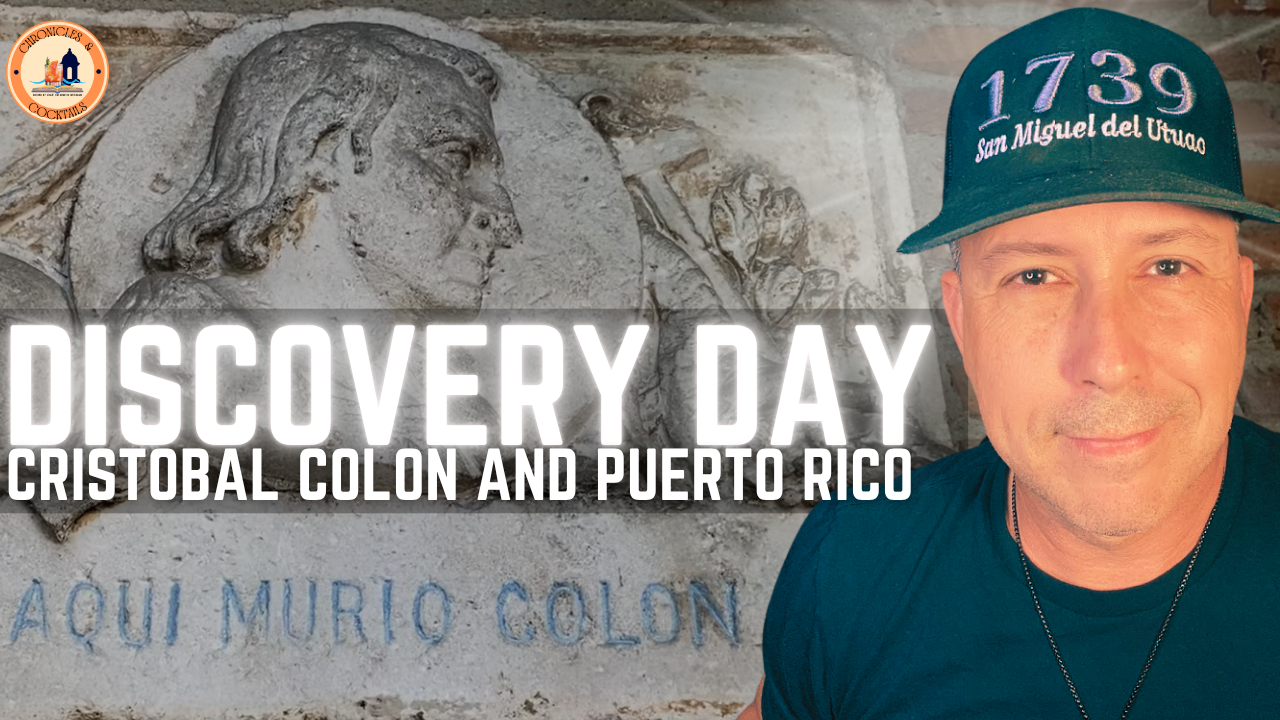
In this special Discovery Day episode of Chronicles & Cocktails, I visit the places where this remarkable story unfolded—from the streets of Madrid and Valladolid to the colonial heart of Santo Domingo and the west coast of Puerto Rico.
Together, we’ll explore the life of Christopher Columbus, the realities of November 19, 1493, and the lasting impact of one of history’s most consequential voyages.
🍹 Featured Cocktail: Chichaíto con Parcha — combining Puerto Rican rum, Spanish anís, and Caribbean passionfruit to symbolize the meeting of cultures that forever changed Puerto Rico.
Continue Exploring Puerto Rico’s History
If you enjoy thoughtful explorations of Puerto Rico’s history, culture, food, cocktails, and travel, be sure to explore more episodes of Chronicles & Cocktails.
You’ll discover the stories behind the people, places, traditions, and events that continue to shape Puerto Rico today.
¡Salud!