
Every holiday season, kitchens across Latin America fill with the aroma of steaming leaves, seasoned meats, and family traditions passed from one generation to the next.
Whether you’re in Puerto Rico, Mexico, Guatemala, Venezuela, Colombia, or Central America, chances are someone is wrapping a special holiday meal in a leaf. But while many people compare Puerto Rican pasteles and Mesoamerican tamales, the truth is they are two very different dishes with two very different histories.
They may be cousins, but they certainly aren’t twins.
Let’s unwrap the story.
Pasteles vs. Tamales: Similar on the Outside, Different at the Core
At first glance, the comparison seems obvious.
Both are wrapped.
Both require hours of work.
Both are treasured holiday foods.
Both are recipes families proudly defend as “the right way.”
But that’s where the similarities mostly end.
Tamales belong to the ancient civilizations of Mesoamerica. Pasteles belong to the Caribbean and tell the story of Puerto Rico’s cultural blending over more than five centuries.
Understanding those differences makes both dishes even more fascinating.
Tamales: One of the Oldest Prepared Foods in the Americas
The tamal is one of the oldest prepared foods still enjoyed today.
Archaeological evidence places tamales in Mesoamerica as early as 1500–800 BCE, long before Europeans reached the Americas. The Maya and later the Mexica (Aztecs) prepared tamales as portable meals for travelers, hunters, merchants, soldiers, and religious ceremonies.
Corn was much more than food.
It was sacred.
According to the Popol Vuh, humanity itself was created from maize. It’s no surprise that tamales became one of the most important foods in Mesoamerican civilization.
Traditional tamales are made from masa (corn dough), filled with meats, vegetables, beans, or chilies, wrapped in corn husks or banana leaves depending on the region, and steamed until firm.
For thousands of years, tamales have remained remarkably recognizable.
The Puerto Rican Pastel: A Story of Cultural Fusion
Unlike tamales, Puerto Rican pasteles developed during the colonial period.
They are not simply “Puerto Rican tamales.”
Instead, they represent the meeting of several cultures.
The indigenous Taíno contributed the use of root vegetables such as yuca (cassava), yautía, and batata, staples documented by early Spanish chroniclers including Bartolomé de las Casas and Gonzalo Fernández de Oviedo.
Spanish settlers introduced new meats, olives, capers, seasonings, and preservation methods.
Africans brought sophisticated culinary techniques that influenced seasoning, preparation, and the communal style of cooking that became central to Caribbean food traditions.
The result was something entirely new.
A Puerto Rican pastel isn’t defined by one culture—it represents all of them.
Plantains Were Not Taíno
One of the most common misconceptions about Puerto Rican cuisine is that plantains have always been part of the island’s food culture.
They haven’t.
Plantains originated in Southeast Asia and reached the Caribbean through Spanish colonial trade after 1516.
Before that, the Taíno relied primarily on root crops like yuca, yautía, and batata.
Today, many pasteles include green plantains in the masa, but this ingredient reflects centuries of cultural evolution rather than indigenous tradition.
Why Making Pasteles Was a Family Event
For generations, making pasteles wasn’t simply cooking.
It was a holiday gathering.
Weeks before Christmas, entire families assembled around large tables covered with banana leaves.
Someone grated the viandas.
Someone seasoned the pork.
Someone prepared the achiote oil.
Someone filled the masa.
Someone wrapped.
Someone tied.
Even children had jobs, whether cleaning banana leaves or passing ingredients.
Hundreds of pasteles might be made over a single weekend.
Many families froze them, enjoying them throughout Christmas and into Lent.
Every household proudly claimed its own recipe was the best.
No measurements.
No cookbook.
Just experience, memory, and tradition.
Why Fewer Families Make Pasteles Today
Modern life has changed many traditions.
Preparing authentic pasteles takes hours of labor.
Grating root vegetables, seasoning meat, wrapping each pastel individually, tying them securely, and boiling them requires time that many families simply no longer have.
Today, many Puerto Ricans purchase their holiday pasteles from local specialists—those wonderful women everyone seems to know in their town.
If you’ve ever ordered homemade pasteles in Puerto Rico, you already know the rule:
Place your order early.
Very early.
Around Christmas, las señoras de los pasteles are about as busy as accountants during tax season.
Pasteles de Yuca: A Personal Favorite
While green plantain pasteles may be the most familiar version, many Puerto Ricans swear by another variety:
Pasteles de yuca.
Instead of relying primarily on green plantains, these use grated cassava as the foundation of the masa.
The result is smoother, silkier, and slightly sweeter.
For me, they’re pure nostalgia.
I first enjoyed pasteles de yuca con carne de cerdo in Utuado. My father used to bring them home, and to this day I still think they’re even better with a generous splash of homemade pique.
Some childhood memories never leave you.
Did Puerto Rican Pasteles Come from Venezuelan Hallacas?
This is where things become especially interesting.
Some culinary historians believe Puerto Rican pasteles may have been influenced by Venezuelan hallacas.
Hallacas share several characteristics:
- Banana leaf wrapping
- Holiday preparation
- Labor-intensive family production
- Meat stew fillings
- Large Christmas batches
However, hallacas use corn masa, while Puerto Rican pasteles use root vegetables.
Some researchers have suggested that Venezuelan immigrants settling in Puerto Rico’s central mountains—including Utuado, Lares, and Orocovis—may have introduced the concept, which then evolved using the crops most abundant in Puerto Rico.
Is this theory universally accepted?
No.
Is it an interesting possibility?
Absolutely.
It deserves thoughtful discussion—not internet arguments.
So… Which One Wins?
Honestly?
Nobody.
Tamales represent one of the oldest surviving culinary traditions in the Americas.
Pasteles tell the remarkable story of Puerto Rico itself—a fusion of Indigenous, European, and African influences wrapped inside a banana leaf.
Comparing them isn’t about declaring a winner.
It’s about appreciating how different cultures solved the same problem in beautifully different ways.
One celebrates maize.
The other celebrates viandas.
Both celebrate family.
Both celebrate tradition.
And both deserve a place on the holiday table.
Watch the Full Episode
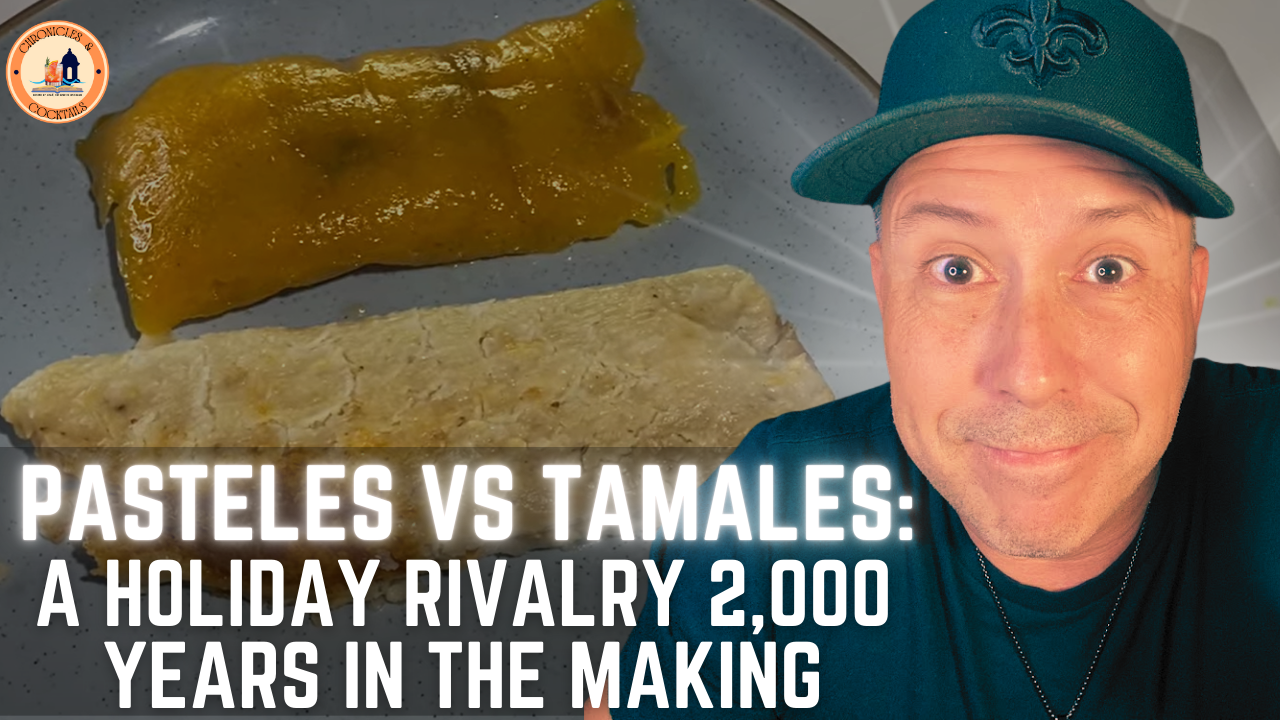
In this episode of Chronicles & Cocktails, I warm both dishes, explore their history with real historical sources, taste them side by side, and mix a refreshing Pineapple–Mint Highball designed to balance the richness of Puerto Rican pasteles.
If you love history, cocktails, travel, and the stories behind the foods we eat, you’re in the right place.
Subscribe to Chronicles & Cocktails on YouTube and join me every Sunday as we explore Puerto Rico—and the world—one story at a time.