
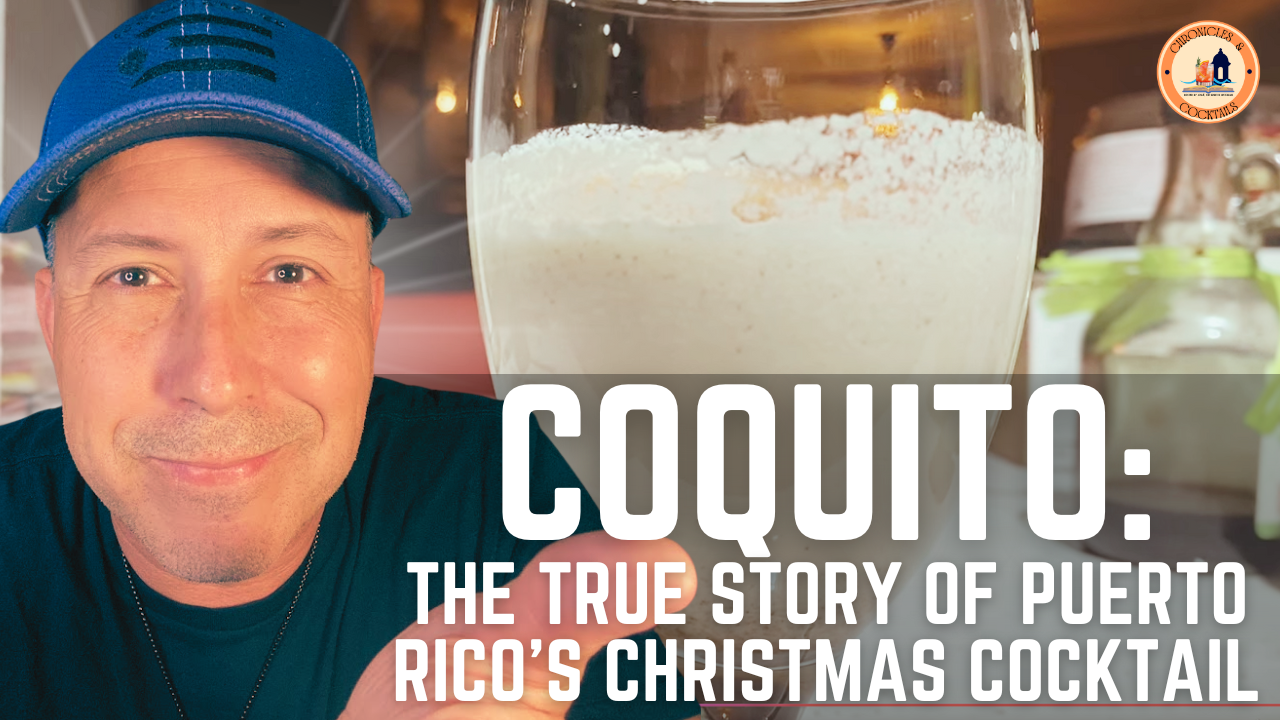
Christmas in Puerto Rico doesn’t arrive quietly—it bursts through the door with music, family gatherings, parrandas, laughter, and, of course, a chilled bottle of coquito waiting in the refrigerator.
For many Puerto Ricans, the first glass of coquito marks the official beginning of the Christmas season. Yet despite its popularity, surprisingly few people know the true story behind Puerto Rico’s most iconic holiday cocktail.
In the latest episode of Chronicles & Cocktails, we explore the fascinating history of coquito, separating tradition from myth while preparing a classic batch using authentic ingredients.
Is Coquito an Ancient Puerto Rican Tradition?
Many people assume coquito dates back to the Spanish colonial era or even to the Taínos. After researching historic Puerto Rican cookbooks and culinary sources, the evidence tells a different story.
There is no known printed recipe for coquito in nineteenth-century Puerto Rican cookbooks, including the landmark El Cocinero Puerto-Riqueño o Formulario (1859). Likewise, Puerto Rican Cook Book by Eliza B.K. Dooly (1948) and the popular Spanish-language edition of Cocina Criolla by Carmen Aboy Valldejuli do not include a recipe for modern coquito.
Instead, what we find is something even more interesting.
The Birth of a Modern Puerto Rican Classic
The earliest printed ancestor of today’s coquito appears in the English-language cookbook Puerto Rican Cookery by Carmen Aboy Valldejuli. Depending on the edition, readers will find recipes such as Coconut Eggnog or Coconut Rum Punch.
These recipes are not modern coquito—they use coconut milk, milk, sugar, spices, and rum rather than condensed milk, evaporated milk, and cream of coconut—but they reveal the transition toward what would eventually become Puerto Rico’s signature Christmas drink.
Rather than being centuries old, coquito appears to be a distinctly mid-twentieth-century Puerto Rican creation, one that evolved inside family kitchens as new ingredients became widely available.
The Three Ingredients That Changed Everything
One of the most fascinating discoveries while researching this episode is that coquito would likely never have existed without three innovations.
Evaporated Milk
Originally developed in the United States during the late nineteenth century, evaporated milk became extremely popular throughout Puerto Rico during the mid-twentieth century because it required no refrigeration before opening, lasted for months, and worked beautifully in desserts and beverages.
Its rich texture helped define countless Puerto Rican recipes, including flan, tembleque, coffee, and eventually coquito.
Sweetened Condensed Milk
Sweetened condensed milk, patented in the nineteenth century, became a household staple throughout Puerto Rico after World War II as canned goods became increasingly common.
It provided the sweetness and silky texture that modern coquito is known for today.
Coco López: Puerto Rico’s Secret Ingredient
Perhaps the greatest twist in coquito’s story is that one of its defining ingredients was invented in Puerto Rico.
In 1948, Professor Ramón López Irizarry of the University of Puerto Rico in Mayagüez developed Coco López, a shelf-stable cream of coconut that forever changed tropical cocktails.
Most people know Coco López as the ingredient that made the Piña Colada famous. It also transformed coquito by giving home bartenders a creamy, sweet, and consistent coconut base unlike anything that had existed before.
Without Coco López, modern coquito simply wouldn’t taste the way it does today.
When Did Coquito Become Puerto Rico’s Christmas Drink?
Although no single inventor has been identified, the historical timeline suggests that coquito became firmly associated with Christmas between the 1950s and the 1980s.
As Puerto Rican families embraced blenders, canned dairy products, and cream of coconut, recipes spread from household to household. Every family developed its own version, often handwritten in recipe books and passed down through generations.
By the 1990s, coquito had become inseparable from Puerto Rican Christmas celebrations both on the island and throughout the diaspora.
Today, whether you’re celebrating in San Juan, Chicago, Orlando, New York, or anywhere else in the world, chances are someone has a treasured family recipe waiting in the refrigerator.
The Great Egg Debate
No discussion of coquito would be complete without addressing one of Puerto Rico’s friendliest holiday arguments.
Should coquito contain egg?
Some families swear by egg yolks, while others insist they have no place in the recipe. Historically, the earliest coconut punches that influenced coquito were eggless, while later versions were likely influenced by the popularity of traditional American eggnog.
As I mention in the episode, I personally belong to the no-egg camp—but if your grandmother made it with eggs, that family tradition deserves to be celebrated.
After all, every bottle of coquito tells a family story.
A Puerto Rican Cocktail Celebrated Around the World
In 2025, Puerto Rico received another reason to celebrate when TasteAtlas ranked coquito as the #1 alcoholic mixed drink in the world, placing it ahead of internationally recognized classics such as Sangria, Mojito, and Pisco Sour.
It was another reminder that some of the world’s greatest culinary traditions don’t come from massive countries or famous capitals.
Sometimes they come from a small Caribbean island with a very big heart.
Watch the Full Episode
In this episode of Chronicles & Cocktails, we prepare a traditional batch of coquito while exploring:
- The true history of Puerto Rico’s Christmas cocktail
- The earliest cookbook references connected to coquito
- The fascinating invention of Coco López
- The history of condensed and evaporated milk
- The egg versus no-egg debate
- Why coquito became one of Puerto Rico’s greatest culinary traditions
Whether you’re making your first bottle or continuing a family tradition that spans generations, I hope this episode helps you appreciate not only the flavor of coquito, but also the remarkable story behind it.
Salud, and Merry Christmas from Puerto Rico.